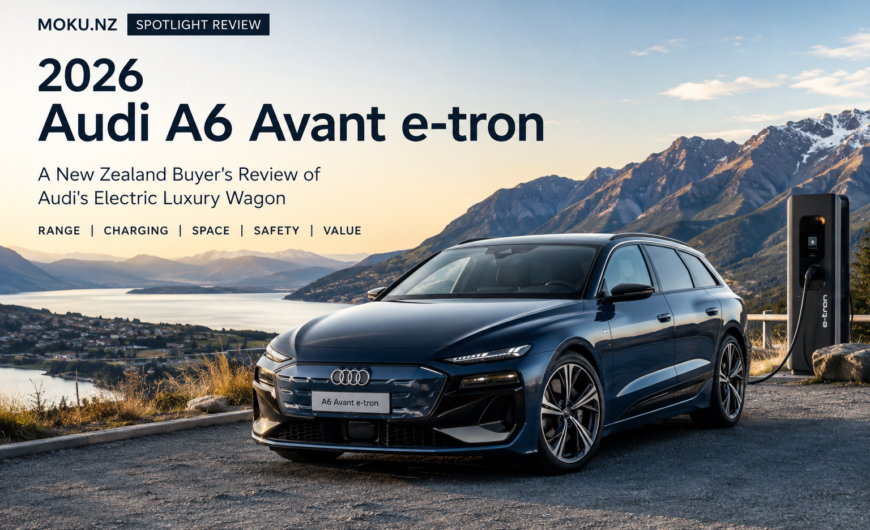
New Zealand’s premium electric-car market is dominated by SUVs, which makes the 2026 Audi A6 Avant e-tron immediately interesting. It combines the low, elegant shape and luggage flexibility of an Audi Avant with a dedicated electric platform, a claimed driving range of up to 650km and rapid DC charging of up to 270kW.
At a current Audi New Zealand MRP of $144,990 before on-road costs and options, this is not a mainstream family EV. It is aimed at buyers who want long-distance ability, strong performance, advanced cabin technology and wagon practicality without moving into another high-riding SUV.
This buyer-focused review assesses the published New Zealand specification, official safety results and practical ownership factors. Specifications and prices can change, while options shown in overseas imagery may not be standard locally, so confirm the exact build and equipment during a test drive before ordering.
Moku verdict: The A6 Avant e-tron is a compelling premium touring EV with genuine family space, excellent claimed range and unusually fast charging capability. Its price, reliance on suitable charging and option complexity mean it rewards a carefully informed buyer rather than an impulse purchase.
2026 Audi A6 Avant e-tron NZ specifications at a glance
| Specification | Current NZ figure | Why it matters |
| Price | $144,990 MRP, excluding ORC and options | Premium positioning; compare the final configured price |
| Power | Up to 315kW; 340kW in launch control | Strong overtaking and performance potential |
| WLTP range | Up to 650km | Long-distance capability, subject to real conditions |
| Maximum DC charging | Up to 270kW | 10-80% claimed in about 21 minutes at a suitable charger |
| Range added | Up to 295km in 10 minutes | Requires favourable battery and charger conditions |
| Boot | 502L; 1,422L with rear seats folded | Useful family and touring capacity |
| Front storage | 27L | Keeps charging cables away from luggage |
| Towing | Up to 2,100kg | Strong for an electric wagon; equipment and limits apply |
| Safety | Five-star ANCAP, 2025 protocols | Applies to all A6 e-tron variants rated by ANCAP |
| Ownership package | 5-year warranty, 3-year motoring plan, 5-year roadside assistance | Adds cost certainty during early ownership |
Sources: Audi New Zealand model information and ANCAP. Figures are manufacturer claims or published ratings; confirm the exact NZ vehicle specification.
What is the Audi A6 Avant e-tron?
The A6 Avant e-tron is not an electric conversion of the conventional A6 wagon. It uses the Premium Platform Electric architecture, shared at platform level with Audi’s Q6 e-tron family, and packages its battery beneath the cabin floor. The result is an EV designed around range, charging speed and interior space from the outset.
The word Avant is Audi’s traditional name for a wagon. That matters because the model serves buyers who want a long roof, a low loading height and car-like road manners, but do not need the bulk or upright seating position of an SUV. In the current Moku content library, Audi’s Q3, Q5 and Q7 have already been compared; this model opens a distinctly different ownership conversation.
Readers still deciding between Audi body styles can use Moku’s existing Audi Q3 vs Q5 vs Q7 guide to understand what the SUV alternatives offer.
Exterior design: an EV that still looks like an Avant
The A6 Avant e-tron avoids the tall, heavy-looking profile common to many large electric vehicles. Its roofline is low and strongly tapered, the wheelbase is visually long, and the wide stance gives it presence without turning it into an SUV. Audi quotes a drag coefficient of 0.24 for the Avant body, an impressive figure for a practical wagon and an important contributor to range.
The closed, inverted Singleframe panel, slim daytime-running lights and darker lower mask identify it as an e-tron. At the rear, the full-width light treatment and illuminated rings create a more digital character. Depending on equipment, buyers can access multiple light signatures and digital OLED rear-light functions.
Some of the most striking features may be optional. Virtual exterior mirrors, switchable panoramic glass and advanced lighting can increase visual drama and cost. Conventional mirrors may be the easier choice for drivers who prioritise natural depth perception, simple repairs and immediate familiarity.
Interior and technology
The dashboard centres on Audi’s curved panoramic display: an 11.9-inch virtual cockpit and 14.5-inch MMI centre screen. A separate 10.9-inch passenger display is available in the broader specification, using a privacy mode intended to prevent entertainment content from distracting the driver.
This is a highly digital cabin, but the useful technology goes beyond screen size. The route planner can include charging stops and prepare the battery for faster charging. The interaction light can communicate selected vehicle events, while the available head-up display places navigation and assistance information into the driver’s forward view.
The risk is cognitive overload. Before buying, test simple actions such as changing temperature, selecting a drive mode, disabling an unwanted assistance alert and finding the 360-degree camera. Good technology should reduce workload after a short learning period. If routine functions remain distracting, the glossy presentation is not enough.
Because modern Audi ownership involves apps, accounts and software, also read Moku’s connected cars in New Zealand guide before deciding which digital features have lasting value.
Passenger space and family practicality
The 502-litre rear luggage area is sensibly shaped and expands to 1,422 litres with the 40:20:40 rear seat folded. A 27-litre front compartment provides a dedicated place for charging cables, reducing the need to unpack holiday luggage when a cable is needed.
For families, the wagon format brings several advantages: easier roof access than a tall SUV, a relatively low load floor for pets or heavy bags, and a long cargo area for prams, sports equipment or flat-packed purchases. The middle rear backrest can fold separately, allowing longer items to travel while two rear seats remain usable.
The sloping roof is part of the design appeal, but taller rear passengers should confirm headroom in person. Families should also install their actual child seats during a test drive, check front-seat space with a rear-facing restraint fitted, and make sure the electric tailgate opens safely in their garage.
Safety: five-star ANCAP protection
ANCAP gives the Audi A6 e-tron a five-star rating under its 2025 criteria, applying to all variants introduced in New Zealand from July 2025. The published scores are 92% for adult occupant protection, 91% for child occupant protection, 75% for vulnerable road-user protection and 77% for safety assist.
Standard rated equipment includes front, side, curtain and centre airbags, plus autonomous emergency braking, lane support and speed assistance. These systems support, but do not replace, attentive driving.
Performance and road manners: what buyers should expect
Audi’s current NZ page quotes up to 315kW, rising to 340kW in launch control. That is considerably more performance than a family wagon needs for daily transport. The practical benefit is effortless merging and overtaking; the responsibility is to use that response smoothly, especially on wet roads and around passengers.
The battery’s low position should support a planted feel, while adaptive air suspension broadens the range between comfort and body control. Large wheels may sharpen appearance but can reduce ride comfort, add tyre cost and slightly affect efficiency. A proper New Zealand test drive should include urban bumps, coarse-chip motorway surfaces, a steep driveway and a tight parking building rather than only smooth roads near the showroom.
Regenerative braking can be adjusted through steering-wheel paddles in three stages or managed automatically. Drivers should test how predictable the transition feels as the car blends regeneration with its mechanical brakes. A natural, repeatable brake response matters more in everyday ownership than an impressive maximum regeneration figure.
Range and charging in New Zealand
The headline WLTP range is up to 650km. WLTP is best used for comparing vehicles, not promising a fixed trip distance. Speed, temperature, wind, rain, hills, tyre pressure, roof loads, towing and cabin heating or cooling can all change consumption. A prudent buyer should plan around a usable buffer rather than arriving at a charger with the battery close to empty.
The 800-volt electrical system enables a claimed 10-80% DC charge in about 21 minutes and up to 295km of added WLTP range in ten minutes, but only when the charger can deliver sufficient power and the battery is at a suitable temperature and state of charge. Preconditioning through the route planner is therefore more than a convenience on a long trip.
At home, overnight AC charging is the normal foundation of convenient EV ownership. Buyers should obtain a site-specific quote from a registered electrical professional, confirm the household supply and select compliant equipment. Apartment residents and renters should settle body-corporate, landlord, parking and billing arrangements before assuming home charging will be available.
For a full setup and safety checklist, use Moku’s EV home charging in New Zealand guide.
Running costs, RUC and ownership realities
Electric driving removes petrol costs and routine oil changes, but it does not make a premium car inexpensive. New Zealand battery-electric vehicles pay road user charges. The current standard light-BEV rate published by NZ Transport Agency is $76 per 1,000km, before any transaction fees. At 15,000km a year, the distance charge alone is about $1,140.
Electricity cost depends on where and when the car is charged. Home off-peak charging may be substantially cheaper than repeated high-power public charging, while efficiency losses mean the energy drawn from the wall is slightly higher than the energy stored in the battery. Use your actual electricity tariff and realistic annual kilometres instead of a generic savings claim.
Other costs remain significant: comprehensive insurance, depreciation, premium tyres, wheel damage, optional-equipment replacement and out-of-warranty electronics. Audi’s five-year warranty, three-year motoring plan and five-year roadside assistance provide useful early-ownership support, but buyers should request the exact battery warranty and motoring-plan terms in writing.
Set a complete budget with Moku’s guide to car ownership costs in New Zealand rather than comparing energy prices alone.
Strengths and compromises
| Strong reasons to buy | Points to consider carefully |
| Up to 650km claimed WLTP range | Real range will vary with speed, weather, load and options |
| Up to 270kW DC charging capability | Maximum speed needs a compatible charger and prepared battery |
| 502L boot plus 27L front storage | Lower roofline may not suit every tall passenger or bulky load |
| Five-star ANCAP rating | Assistance systems still require attentive driving |
| Distinctive wagon alternative to an SUV | Premium purchase price and potentially costly options |
| 2,100kg maximum towing claim | Towing can materially reduce range; exact limits must be followed |
Moku assessment based on the current New Zealand specification and practical ownership considerations.
Who should buy the Audi A6 Avant e-tron?
The A6 Avant e-tron makes the most sense for a professional or family buyer who wants a premium EV for commuting and regular intercity travel, has reliable home or workplace charging, values wagon practicality and intends to keep the vehicle long enough to enjoy its refinement beyond the initial novelty.
- Strong fit. You prefer a low, refined wagon to an SUV; need a large boot; can charge routinely at home; and will use the long range for real travel.
- Consider alternatives. You need seven seats, maximum ground clearance, the lowest purchase cost, very simple controls or cannot secure dependable overnight charging.
- Test before ordering. Confirm rear-seat comfort, ride quality on the chosen wheels, mirror preference, assistance-system behaviour, charging setup and the final price with every desired option.
New NZ car or future used import?
A new Audi New Zealand vehicle provides clear local specification, warranty and distributor support. A future used import from Japan or another market may create a lower entry price or different equipment choices, but an electric premium vehicle requires extra checks: charging-port compatibility, app and account support, battery condition, recall completion, infotainment region, warranty transfer and parts availability.
Moku explains the broader process in its complete guide to direct-import cars from Japan. Any A6 e-tron import should be assessed by chassis number rather than assumed to match the NZ-new specification.
You can also review how much it costs to import a car to New Zealand before comparing an auction price with a locally registered vehicle.
Test-drive and ordering checklist
- Final price. Obtain an itemised quote including ORC, paint, wheels, packages, tow equipment and charging accessories.
- Range display. Ask how recent driving affects the estimate and review the trip-consumption screen.
- Charging. Confirm AC capability, supplied cables, connector type, charge scheduling and battery preconditioning.
- Ride and tyres. Drive coarse surfaces and note the exact tyre size, replacement price and repair options.
- Family fit. Load child seats, pram or work gear; check rear headroom and tailgate clearance.
- Technology. Pair your phone, test navigation, cameras, common climate controls and driver-assistance settings.
- Ownership cover. Read the vehicle warranty, battery warranty, motoring plan and roadside-assistance conditions.
- Insurance. Obtain a quote using the exact model, value, drivers, address and optional equipment before paying a deposit.
Frequently asked questions
How much is the Audi A6 Avant e-tron in New Zealand?
Audi New Zealand currently lists the A6 Avant e-tron from $144,990 MRP. On-road costs and optional equipment are additional, and pricing can change.
What is its claimed driving range?
The current NZ model page states up to 650km on the WLTP cycle. Actual range depends on conditions, speed, load, temperature, tyres and accessory use.
How quickly can it charge?
Audi claims up to 270kW DC charging, around 21 minutes from 10% to 80%, and up to 295km of added WLTP range in ten minutes at a suitable high-power charger under favourable conditions.
Is the A6 Avant e-tron safe for families?
It has a five-star ANCAP rating under 2025 criteria, including scores of 92% for adult and 91% for child occupant protection. Correct restraints and attentive driving remain essential.
How large is the boot?
Audi quotes 502 litres behind the rear seats and 1,422 litres with them folded. There is also a 27-litre storage compartment beneath the bonnet.
Can it tow?
Audi states a trailer load of up to 2,100kg. Confirm the exact vehicle, towbar, braked and unbraked limits, download limits and licence requirements; expect towing to reduce range.
Does it pay road user charges in NZ?
Yes. As a light battery-electric vehicle, it requires a RUC distance licence. NZTA currently publishes a standard rate of $76 per 1,000km, plus applicable purchase fees.
Is it a better choice than an Audi SUV?
Choose it if you value a lower driving position, wagon loading and aerodynamic efficiency. An Audi SUV may suit buyers who want a higher seating position, greater ground-clearance feel or seven-seat availability.