Agreed vs Market Value Car Insurance in NZ: Which Is Better?
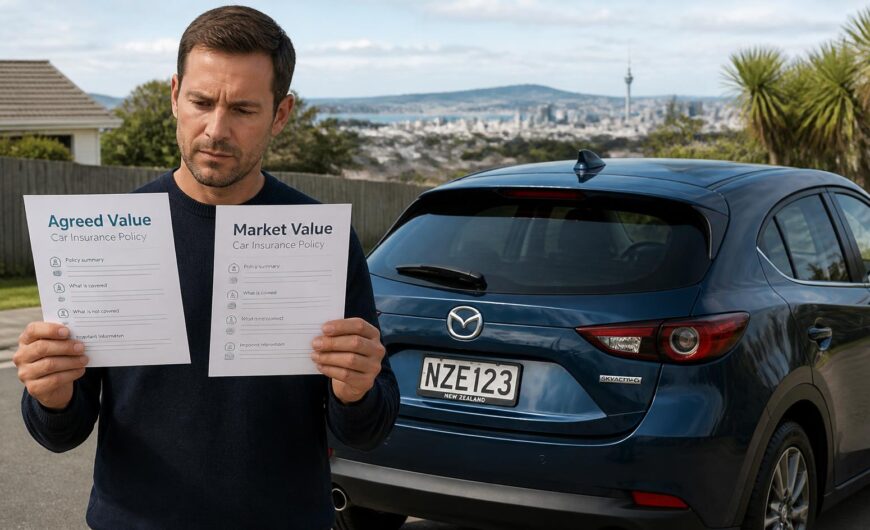
When you compare comprehensive car insurance in New Zealand, the words agreed value and market value can look like a minor policy setting. They are not. The choice helps determine how a total-loss claim is valued if your car is stolen and not recovered, written off after a crash, or damaged beyond economical repair.
Agreed value offers more certainty because you and the insurer set the insured amount at the start of the policy and usually revisit it at renewal. Market value follows what the vehicle was worth immediately before the loss, so the final figure is assessed only when you claim. Either can be sensible. The better option depends on the vehicle, your budget, how easy it would be to replace the car, and the exact wording of the policy.
This guide explains agreed vs market value car insurance in NZ, the questions to ask before choosing cover, how premiums and excesses fit into the decision, what to check at renewal, and how to respond if a valuation seems wrong.
Quick answer: Choose agreed value when a predictable total-loss settlement matters and the insurer will accept a realistic figure that would help you replace the car. Market value can suit an ordinary vehicle with plenty of comparable sales and a meaningful premium saving. Never compare the value basis alone: check the policy limit, excesses, exclusions, driver rules and benefits as a package.
What is agreed value car insurance?
Consumer Protection defines agreed value as a value you and the insurer agree on when the policy begins and each time it renews. Under a genuine agreed-value policy, that figure is the basis for a covered total-loss settlement, subject to the policy terms and any deductions that apply. The schedule should clearly state the amount.
The main advantage is certainty. You know the starting point before a claim rather than waiting for a post-loss valuation. That can be useful when the car is unusual, recently purchased, fitted with declared accessories, or difficult to match in the local market. It can also make financial planning easier if losing the vehicle would force you to find replacement transport quickly.
Agreed does not mean permanent. The Insurance Council of New Zealand advises policyholders to check the figure at every renewal because an insurer may change it. A renewal notice can reduce the amount to reflect depreciation or changed market conditions. If you let the policy roll over without reading the schedule, you may have accepted a lower value than expected.
What is market value car insurance?
Market value is what the vehicle was worth immediately before the insured damage or loss. The insurer generally considers the make, model, year, mileage, condition, specifications and relevant market evidence. The figure is not automatically the original purchase price, the amount still owed on finance, the highest online asking price, or the maximum number printed elsewhere on a schedule.
Market value can track depreciation without an annual negotiation and may cost less than insuring an optimistic agreed amount. It often works best when the vehicle is common and there are enough genuinely comparable New Zealand cars to support a fair valuation. The trade-off is uncertainty: neither you nor the insurer knows the exact settlement figure until the market is assessed at the time of loss.
Read the definition in the policy rather than relying on the quote screen. Some schedules show a sum insured or limit even where the settlement clause remains market value. The Insurance and Financial Services Ombudsman warns that the amount shown on a schedule can be higher than the actual market-value settlement. The operative wording is what matters.
Agreed value vs market value: side-by-side
| Question | Agreed value | Market value |
| When is the value set? | At policy start and usually reconsidered at renewal | After the loss, using the vehicle’s pre-loss value |
| Payout certainty | Higher, if the wording truly guarantees the stated amount | Lower, because the final valuation is claim-time evidence |
| Depreciation | Reflected when the agreed amount is reviewed or changed | Reflected automatically in the pre-loss market assessment |
| Premium impact | May cost more when the insured amount is higher | May be cheaper, but quotes must be compared like for like |
| Best fit | Unusual cars, hard-to-replace specifications, or owners wanting certainty | Common cars with strong comparable-sales evidence |
| Main risk | Value quietly falls at renewal, or an unrealistic amount is not accepted | Settlement may be lower than the owner expected |
General comparison only. Policy definitions, settlement clauses and deductions vary by insurer; always read the current policy wording and schedule.
How a total-loss settlement works
A total loss occurs when the car cannot be recovered or the insurer decides repair is unsafe or uneconomic under the policy. The insurer then applies the settlement basis in the contract. With agreed value, the stated amount is normally the starting point. With market value, the insurer obtains or reviews valuation evidence for the car immediately before the loss.
The net payment may still be less than the headline value. Depending on the wording, an insurer may deduct the applicable excess, unpaid annual premium instalments, or other amounts allowed by the contract. If the car is financed, the insurer may need to recognise the lender’s interest. A policy payout is not designed to clear negative equity automatically, so do not choose the insured value by looking only at the loan balance.
Illustrative example: A policy shows an agreed value of $20,000 and a $750 accident excess. If a covered total loss is settled on the stated agreed value, the starting figure is $20,000, but the amount reaching the policyholder may be reduced by the excess and any other permitted deductions. By contrast, a market-value policy would first assess the car’s pre-loss value; it could be above or below $20,000. This example is not a quote or guarantee.
Is agreed value always better?
No. Certainty has value, but it is not useful at any price. An agreed-value quote can carry a higher premium, and setting an amount well above the realistic replacement market may be expensive or unavailable. Conversely, choosing a very low agreed amount to save on premium can leave a serious replacement gap after a write-off.
Agreed value is strongest when the number is evidence-based and the premium difference is reasonable. It can be particularly attractive for a late-model car bought recently, a less common Japanese import with a specific trim or safety package, a carefully maintained enthusiast vehicle, or a vehicle with declared accessories that would be costly to replicate.
When market value may be the practical choice
- Your car is a common make, model and grade with plenty of comparable listings and sales evidence.
- The vehicle’s value is modest and the extra premium for agreed value would materially reduce affordability.
- You are comfortable with normal depreciation and can absorb some uncertainty in the replacement budget.
- The insurer’s market-value definition, valuation process and dispute pathway are clear.
- You have compared the entire policy and the market-value option provides the best overall cover, not merely the lowest premium.
How to choose a realistic insured value
Start with replacement reality, not sentiment. Ask what it would cost today to buy a genuinely comparable car in New Zealand, allowing for the same year, grade, powertrain, mileage, condition, safety specification and meaningful accessories. A one-off asking price is weak evidence; use a range of comparable vehicles and note important differences.
For a newly purchased vehicle, keep the sale agreement, pre-purchase inspection, photographs and accessory invoices. For an unusual, classic or modified car, ask whether the insurer requires a specialist valuation. Tell the insurer about modifications and non-standard use before relying on the quote. Undeclared changes can affect cover, while some accessories may have sub-limits unless specifically listed.
A practical valuation process
- Identify the exact vehicle: year, make, model, grade, engine or battery, drivetrain, odometer and key factory options.
- Collect several recent New Zealand comparisons, excluding cars with materially different mileage, condition or specification.
- Adjust for documented condition, service history, recent major work and declared accessories without treating normal maintenance as a dollar-for-dollar increase.
- Ask the insurer how it defines market value or sets agreed value, and what evidence it would consider after a total loss.
- Save the quote, policy wording, schedule, valuation evidence and any written answers from the insurer.
- Repeat the check at every renewal and after a major change to the vehicle or its use.
Compare the whole policy, not just the payout label
Consumer Protection advises drivers not to compare car insurance on price alone. A low premium can come with a large excess, narrower driver cover, limited transport benefits or exclusions that matter to the way you use the car. Compare quotes on the same facts and value basis, then work through the details below.
| Policy feature | What to check | Why it matters |
| Base and additional excesses | Standard, young-driver, inexperienced-driver, theft and special excesses | Several excesses may apply to one event; make sure you could pay them |
| Drivers | Named-driver rules, age limits, licence conditions and occasional drivers | A cheaper restricted-driver policy may not suit a shared household car |
| Use | Private, commuting, occasional business, delivery or rideshare | Use outside the declared category may not be covered |
| Repairs | Choice of repairer, approved network, parts policy and workmanship guarantee | These affect convenience, repair quality and how disagreements are handled |
| Transport | Rental car, alternative transport, towing and roadside help | A write-off or long repair can create costs beyond the vehicle damage |
| Glass and accessories | Windscreen excess, panoramic roof, cameras, tow bar, roof racks and child seats | Modern calibration and accessory costs can be significant |
| Uninsured-driver benefit | Identification requirements, limits and excess treatment | The benefit may depend on proving the other driver’s involvement |
Policy benefits and conditions differ. Use the insurer’s current policy wording and quote schedule for a like-for-like comparison.
Premiums and excesses: the affordability test
Your premium is the price of transferring insured risk to the insurer. The quote may reflect the vehicle, repair and parts costs, where it is kept, driver ages and histories, claims experience, security, use and the cover selected. A higher insured amount can affect the premium, but it is only one input.
The excess is the portion you pay when an accepted claim requires it. Consumer Protection notes that choosing a higher excess can reduce the premium because you retain more risk. That saving only works if the excess remains affordable on a bad day. Compare the annual premium plus the excess you might realistically face, and check whether multiple excesses can be added together.
Budget rule: Do not raise the excess beyond the cash you could access promptly after a crash, theft or weather event. Insurance that is cheap to buy but unaffordable to claim on can fail when you need it most.
Three common driver scenarios
| Scenario | Likely starting point | What to verify |
| Late-model family SUV | Agreed value may provide useful replacement certainty | Renewal value, repairer terms, rental-car benefit, safety-sensor calibration and affordable excess |
| Common older hatchback | Market value or third party, fire and theft may be cost-effective | Actual replacement range, premium-to-value ratio, theft cover and third-party liability limit |
| Unusual import or modified car | Evidence-backed agreed value may reduce valuation uncertainty | Exact grade, declared modifications, parts availability, specialist valuation and policy restrictions |
These are decision prompts, not personal recommendations. The right cover depends on the quote, policy wording, vehicle and household finances.
Your annual car-insurance renewal checklist
Insurance is not a set-and-forget purchase. ICNZ recommends checking that the market or agreed value is still accurate and reading the renewal schedule carefully. Use the renewal date as a prompt to update both the car details and the household’s needs.
- Recheck the car’s realistic replacement range using comparable New Zealand vehicles.
- Confirm whether the agreed value has changed and whether you actively accept the new amount.
- Update the main driver, other drivers, ages, licence status, offences and claim history.
- Tell the insurer about modifications, accessories, a new address, garage arrangements or changed vehicle use.
- Compare the standard excess and every additional excess, not only the premium.
- Check add-ons such as glass, rental car and roadside assistance for duplication or gaps.
- Download the new schedule and policy wording, then keep them with the quote and valuation evidence.
Common mistakes that can undermine a claim
The value basis matters most in a total loss, but everyday policy conditions can decide whether the claim is covered at all. Consumer Protection and ICNZ highlight recurring problems involving unsafe vehicles, undeclared drivers or modifications, licence breaches, business use, alcohol or drugs, and failure to take reasonable care.
- Assuming comprehensive means everything. Comprehensive is broad, not unlimited. Wear and tear, mechanical breakdown, incorrect fuel, tyre-only damage and pre-existing damage are commonly outside standard motor cover.
- Letting the wrong driver use a named-driver policy. Check whether occasional or young drivers are covered and whether an extra excess applies.
- Changing the vehicle without telling the insurer. Performance, suspension, wheels, cosmetic work and accessories can affect underwriting and settlement.
- Using a private policy for deliveries or rideshare work. Business and fare-paying use may need different cover or an endorsement.
- Ignoring roadworthiness or licence conditions. A serious breach connected with the loss can affect the claim.
- Authorising repairs before approval. Contact the insurer first unless immediate action is necessary to keep people safe or prevent further loss.
What to do if you disagree with a market valuation
Ask the insurer for the valuation basis and the comparable vehicles used. Check whether the examples match your exact grade, year, mileage, condition and equipment. Build a concise evidence pack with dated listings, service records, pre-loss photographs, purchase documentation and any appropriate independent valuation. Explain specific differences rather than simply stating that the offer feels low.
If the issue is not resolved, make a formal written complaint through the insurer’s internal process and keep a record of every response. New Zealand retail financial service providers must belong to a free, independent dispute resolution scheme. Consumer Protection says those schemes can consider insurance-policy and claim disputes and may change amounts paid where appropriate. Your policy, insurer website or Financial Service Providers Register should identify the scheme.
Evidence tip: Online advertisements show asking prices, not necessarily completed sale prices. They can still help if the vehicles are genuinely comparable and you explain adjustments for mileage, condition, grade and location. Quality of evidence is more persuasive than quantity.
Frequently asked questions
What is the difference between agreed value and market value car insurance in NZ?
Agreed value is the amount you and the insurer set at policy start and normally review at renewal. Market value is the vehicle’s value immediately before the loss, assessed when a claim occurs. The first offers more certainty; the second follows the market.
Does agreed value guarantee the exact amount on my schedule?
It should be the settlement basis for a covered total loss under a genuine agreed-value policy, but the contract may allow deductions such as an excess or unpaid premium instalments. Read the settlement clause and ask the insurer to explain any limits in writing.
Can an insurer change my agreed value at renewal?
Yes. ICNZ advises that insurers may change the agreed value at renewal, so check the new schedule rather than assuming last year’s figure continues. Contact the insurer before renewal if the amount no longer reflects a realistic replacement value.
How does an insurer calculate market value?
The assessment typically considers the vehicle’s make, model, grade, year, mileage, condition, specification and relevant market evidence immediately before the loss. The precise definition and process are set by the policy.
Is the sum insured the same as an agreed value?
Not necessarily. A schedule may show a maximum or sum insured while the settlement clause still says market value. Confirm that the policy explicitly uses agreed value for a total loss.
Should I insure my car for the amount I paid?
The purchase price is useful evidence, especially soon after buying, but the right figure is the amount the insurer will accept under its valuation method. Prices and vehicle condition change, so review the value at renewal.
Will car insurance pay off all my vehicle finance after a write-off?
Not automatically. The claim follows the policy’s insured-value and settlement terms, while the loan follows the credit contract. If the loan balance exceeds the net insurance settlement, a shortfall may remain.
Is third-party car insurance enough for a low-value vehicle?
It may be a practical option when comprehensive cover costs too much relative to the car’s value and you could absorb losing your own vehicle. Third party mainly protects against damage you cause to other people’s vehicles or property; it does not generally cover accidental damage to your own car.
Final recommendation
Choose the policy that creates the smallest unpleasant surprise, not simply the lowest annual premium. Agreed value can be worth paying for when replacement certainty matters and the stated amount is realistic. Market value can be efficient for a common car with clear comparable evidence and an owner who can tolerate some claim-time uncertainty.
Before buying or renewing, compare the settlement definition, insured amount or limit, all excesses, driver and use restrictions, repair terms, transport benefits and common exclusions. Save the documents and repeat the valuation check every year. That small amount of preparation can make a total-loss claim much easier to understand and challenge if necessary.
Looking for a vehicle that fits both your budget and insurance costs? Browse cars and practical ownership guides at Moku.nz before you commit, then obtain like-for-like insurance quotes for the exact model and drivers.