EV Home Charging in New Zealand: Costs, Setup, Safety and Smarter Overnight Charging
For many New Zealand motorists, the best part of owning an electric vehicle is starting each morning with useful range already in the battery. Home charging turns the driveway or garage into a convenient refuelling point, usually at a lower cost than relying on public rapid chargers. It also removes much of the day-to-day concern about finding an available charger.
The right setup depends on how far you drive, the size of your EV battery, your home’s electrical capacity, where the car is parked and the electricity plan available at your address. A portable 3-pin cable may cover occasional top-ups, but a properly installed smart wall charger is generally the safer, faster and more flexible long-term option.
This guide explains EV home charging in NZ in practical terms: charger types, likely upfront and running costs, charging times, installation checks, off-peak plans, solar, rentals and apartments, and the mistakes to avoid before you buy.
Quick answer: For most homeowners who drive an EV regularly, a 7 kW smart wall charger installed by a registered electrician is the sensible all-round choice. EECA says smart wall chargers cost about $1,000-$1,500, with a typical installation of $500-$1,000 before any switchboard, wiring or trenching upgrades.
Why home charging matters for NZ EV owners
Home charging is already the dominant way New Zealanders power their plug-in vehicles. EECA’s 2025 research found that home charging was the main method for 75% of battery-electric vehicle drivers and 55% of plug-in hybrid drivers. It also found that one in five BEV and PHEV drivers relied entirely on public charging, a group more likely to be younger, Auckland-based and renting.
That difference matters when choosing an EV. A vehicle that is easy to own with secure off-street charging can be less convenient for someone who parks on the road or changes rentals frequently. Before focusing only on advertised range, decide where the vehicle will normally charge and how many kilometres must be replaced between trips.
Your main home-charging options
Home EV charging is AC charging. The charger controls and safely supplies electricity, while the vehicle’s onboard charger converts that AC power for the battery. The car’s onboard limit, the household supply and the installed charger all affect the actual speed. A 22 kW unit will not make a car with a 7 kW onboard AC limit charge at 22 kW.
1. Portable 3-pin charging cable
A manufacturer-supplied portable cable can plug into a suitable New Zealand household socket. WorkSafe notes that most units draw up to 10 amps. In typical conditions, this is roughly a 2 kW charge and may add around 10-15 km of range per hour, depending on the EV and charging losses.
This can be enough for a modest commute or a smaller-battery EV that is topped up overnight. However, EECA says portable chargers are not designed to be the primary long-term means of home charging, particularly for higher-capacity EVs. A socket used for sustained charging also needs to be in good condition and on suitable wiring.
2. Dedicated smart wall charger
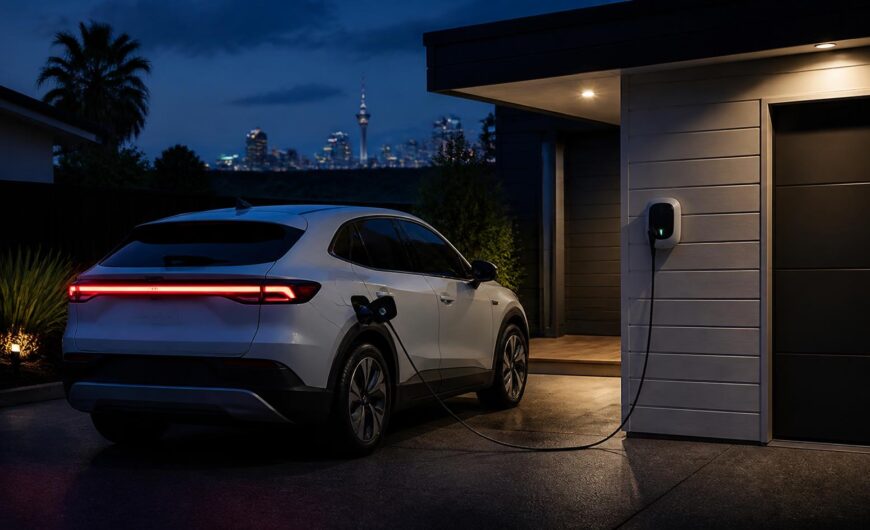
A wall-mounted charger has a dedicated electrical connection and can schedule charging, record energy use and, on compatible models, balance demand against the rest of the house. EECA says approved smart chargers are at least three times faster than a 3-pin plug. A common single-phase installation is around 7 kW, which can add approximately 35-45 km of driving range per hour for an efficient modern EV.
For most households, this is the sweet spot: fast enough to restore a normal day’s driving overnight without paying for three-phase capacity that the house or vehicle may not use.
3. Higher-power three-phase charging
Homes that already have three-phase power may be able to support 11 kW or, in some cases, 22 kW AC charging. This can suit multiple EVs, very high daily mileage or a vehicle with a higher onboard AC charging limit. It is not automatically better. Installation can cost more, and the car may cap the speed well below the charger’s rating.
| Home option | Typical power | Approx. range added | Best suited to | Main limitation |
| Portable 3-pin cable | About 2 kW | 10-15 km/hour | Occasional use, small top-ups, low daily distance | Slow; socket and wiring suitability are critical |
| Single-phase smart wall charger | About 7 kW | 35-45 km/hour | Most regular EV users and overnight charging | Needs professional installation and off-street parking |
| Three-phase wall charger | 11-22 kW | Vehicle-dependent | High mileage, multiple EVs or compatible premium models | Higher cost; may be limited by vehicle or home supply |
Charging speeds are indicative. Actual results depend on the vehicle’s onboard charger, battery temperature, state of charge, household supply and charging losses.
How much does an EV home charger cost in NZ?
EECA’s current consumer guidance estimates $1,000-$1,500 for a smart wall charger and $500-$1,000 for a typical installation. That places a straightforward supply-and-install project at roughly $1,500-$2,500. Treat this as a planning range, not a fixed quote.
The installation price can rise when the charger is far from the switchboard, underground trenching is needed, the switchboard or mains supply requires an upgrade, cable routes are difficult, or dynamic load management is added. A site assessment before buying the hardware reduces the risk of choosing a charger that cannot be installed economically.
Questions to ask for a comparable quote
- Is the charger, cabling, protective equipment and commissioning included?
- Does the price include a dedicated sub-circuit and the correct RCD or equivalent protection for the selected EVSE?
- Are switchboard work, trenching, wall penetrations and weatherproofing included or provisional?
- Will the installer provide the Certificate of Compliance and Electrical Safety Certificate?
- Is load balancing included, and will it work if the household later adds solar, a battery or a second EV?
- What warranty applies to the charger, installation and app or connectivity service?
What will charging cost each night?
The electricity component is simple to estimate. Multiply the energy drawn from the grid by your electricity rate. Remember that charging is not perfectly efficient, so the grid normally supplies slightly more energy than the battery stores.
Illustrative example: A 60 kWh battery charged from 20% to 80% stores 36 kWh. Assuming 90% charging efficiency, the home draws about 40 kWh. At 25 cents per kWh, the electricity cost is about $10. At 15 cents off-peak, it is about $6. Your retailer’s rates and the vehicle’s efficiency will change the result.
EECA’s 2026 comparison includes electricity and road user charges. Its model estimates about $14 per 100 km for an EV charged at home on a standard rate, $11 on an off-peak overnight rate, and $19 using a public fast charger. These are broad comparison figures, not a promise for every vehicle, power plan or charging network.
Battery-electric vehicles also pay road user charges separately from the power bill. NZTA currently lists the usual BEV rate at $76 per 1,000 km, plus the applicable licence administration fee. Keep RUC in your total running-cost calculation even though it does not appear on the charger app.
Use off-peak power without increasing the rest of the bill
Time-of-use plans can make home charging cheaper because the price changes across the day. The Electricity Authority says these plans are particularly suitable for EV owners who can shift charging overnight. Typical time bands are peak from 7 am-10 am and 5 pm-9 pm, shoulder from 10 am-5 pm and 9 pm-11 pm, and the cheapest night period from 11 pm-7 am. Your retailer’s actual times and prices may differ.
Do not choose a plan only because it advertises a cheap or free EV window. Compare the whole household bill, including higher peak rates, daily charges, controlled-load pricing and the amount of charging that genuinely fits inside the discounted period. A smart charger or the vehicle’s own timer can delay charging automatically.
A safe home-charger installation checklist
EV charging is a sustained electrical load, so installation quality matters. WorkSafe and EECA recommend purpose-designed equipment, correct protection and professional installation for wall-mounted units.
- Start with a registered electrician. Ask for an assessment of the switchboard, existing wiring, earthing, available capacity and cable route before selecting the final charger.
- Use equipment intended for New Zealand. The charger or cable should suit the vehicle and New Zealand’s 230V supply. Ask the seller for a Supplier Declaration of Conformity.
- Install a dedicated sub-circuit. EECA’s guidance says the electrician should use a separate circuit and cabling capable of the charger’s output; a 32 amp circuit can help futureproof a typical installation.
- Specify compliant fault protection. Ask the electrician to confirm the RCD and DC fault protection required for the selected unit. EECA’s consumer guidance calls for a Type B RCD for EV charging.
- Choose a practical location. Keep the charger outside the car’s impact path, away from doorways and trip hazards, with enough ventilation and a cable that can reach the charge port of a future vehicle.
- Plan for weather and drainage. An outdoor charger must be rated and installed for its environment. Keep plugs and connectors off the ground and follow the manufacturer’s storage instructions.
- Collect the paperwork. Keep the product documentation, Supplier Declaration of Conformity, commissioning record, Certificate of Compliance and Electrical Safety Certificate.
Home charging safety rules that should never be shortcuts
- Do not use an extension lead, multi-box, double plug or travel adaptor for EV charging.
- Do not use damaged, faulty or modified charging equipment, including overseas equipment altered to accept a New Zealand plug.
- Do not run a charging cable across a public footpath.
- Only use a vehicle adaptor confirmed as compatible by the vehicle and charging-equipment manufacturers.
- Stop using equipment that becomes unusually hot, smells burnt, trips protection repeatedly or shows damaged insulation, and have it checked.
How to choose a smart EV charger
Price is only one part of the decision. EECA maintains an approved list of residential and commercial smart chargers assessed for efficiency and smart functionality; the list was updated in June 2026. Use that as a starting point, then confirm the following with the supplier and installer.
- Vehicle compatibility. Check the EV’s AC inlet, maximum onboard AC rate and whether you need a tethered cable or a socketed unit. This is especially important for used Japanese imports.
- Power level. Match the charger’s output to the vehicle and available home supply rather than paying for an unused headline figure.
- Scheduling and tariff control. The charger should reliably start in your chosen off-peak window and allow an immediate override when needed.
- Dynamic load management. This reduces charger output when the home is using substantial power, helping avoid overload and potentially expensive supply upgrades.
- Solar integration. If solar is installed or planned, check whether the charger can prioritise surplus generation and whether extra metering hardware is required.
- Connectivity and support. Ask what happens if Wi-Fi, mobile service or the vendor’s cloud platform is unavailable, and whether core charging still works locally.
- Cable reach and placement. A longer practical cable and sensible mounting point can be more valuable than a feature-heavy app.
- Warranty and local service. Confirm product warranty, installer workmanship cover, spare-part availability and who provides support in New Zealand.
Can you charge an EV from home solar?
Yes. A compatible smart charger can be configured to use surplus solar generation, reducing the amount exported to the grid. The benefit depends on whether the EV is at home during sunny hours, the size of the solar system, household demand, the export credit and the cost of imported power.
Solar does not automatically mean free charging. There is an opportunity cost when exported electricity earns a credit, and some chargers need extra meters or current clamps to follow solar output. Ask the solar and charger installers to confirm that the systems communicate correctly. Vehicle-to-home and vehicle-to-grid charging are emerging in New Zealand, but EECA says availability, vehicle compatibility and standards are still developing; buy for today’s reliable needs rather than assuming future two-way capability.
Renters, apartments and homes without off-street parking
A fixed charger changes the property’s electrical installation, so renters should obtain written landlord approval before committing to equipment or electrical work. Agree who owns the charger, who pays for removal or reinstatement, how usage is metered and what happens at the end of the tenancy.
In an apartment or unit-title development, start with the body corporate or building manager. A workable proposal should identify the allocated parking bay, cable route, building capacity, fire and access considerations, charger ownership, electricity metering, billing and a fair approach for future residents who also want chargers. Load-managed shared infrastructure may scale better than unrelated individual units.
If you park on the street, do not run a cable over the footpath. Consider whether reliable workplace, destination or close-to-home public charging can support your normal week before buying. EECA’s 2025 research found that public-only drivers exist, but charging cost, proximity, waiting time and speed can materially affect convenience.
Charging habits that support convenience and battery care
Most drivers do not need to recharge from nearly empty every night. Plug in when convenient, schedule the energy you need, and follow the vehicle manufacturer’s recommended everyday charge limit. Many EVs allow a routine target below 100%, with a full charge reserved for longer trips. For public DC charging, EECA recommends taking only what you need and often stopping around 80%, because the final portion is slower.
Pre-condition the cabin while the car is still plugged in when the vehicle supports it, especially on cold mornings. This uses grid power for initial heating and can preserve more battery energy for the trip.
Common home-charging mistakes to avoid
- Buying the charger before the site assessment. A lower-priced unit is not a saving if the switchboard, cable route or protection makes it unsuitable.
- Assuming charger power equals vehicle charging speed. The slowest link – household supply, EVSE or onboard charger – sets the actual AC rate.
- Ignoring the total power-plan cost. A cheap overnight window can be offset by expensive peak power used by the rest of the home.
- Using modified imported equipment. A plug conversion does not prove that the safety electronics suit New Zealand’s electricity system.
- Installing for only the current charge-port location. Position the unit and cable so it can reach either side of a future vehicle.
- Skipping load management in an all-electric home. EV charging can overlap with cooking, water heating and heat-pump demand. Smart control may avoid nuisance tripping or supply upgrades.
- Losing compliance records. Documentation supports warranty claims, future electrical work and a smoother property sale.
Which setup is right for you?
| Your situation | Best starting point | What to verify |
| Low daily distance; small-battery EV | Compliant portable cable may cover occasional top-ups; price a wall charger for long-term use | Socket condition, circuit load, overnight energy required |
| Regular commute; secure driveway or garage | 7 kW smart wall charger | Off-peak schedule, cable reach, load balancing, installation documents |
| High mileage or two EVs | Smart charger with dynamic load management; assess three-phase only if justified | Vehicle AC limits, household maximum demand, second-charger strategy |
| Solar home | Solar-aware smart charger | Export rate, daytime parking, metering hardware, minimum solar charge rate |
| Rental or apartment | Approval and site-wide plan before purchasing hardware | Ownership, metering, billing, parking bay, building capacity |
| No off-street parking | Reliable public, workplace or destination charging plan | Cost, availability, walking distance, backup chargers |
Recommendation guide only. A registered electrician must assess the property before a fixed charger is installed.
Frequently asked questions
Can I charge an EV from a normal 3-pin socket in New Zealand?
Yes, using compatible, unmodified charging equipment designed for the vehicle and New Zealand’s supply. WorkSafe says typical portable units supply up to 10 amps. However, EECA does not recommend a 3-pin portable charger as the main long-term solution, particularly for larger batteries. Never use an extension lead, multi-box or travel adaptor.
How much does it cost to install a home EV charger in NZ?
EECA estimates $1,000-$1,500 for a smart charger and $500-$1,000 for a typical installation. A straightforward project may therefore cost around $1,500-$2,500. Switchboard upgrades, long cable runs, trenching, weatherproofing and load-management hardware can increase the quote.
How long does it take to charge an EV at home?
It depends on the energy required, not simply the battery’s full capacity. Adding 36 kWh to a 60 kWh battery – equivalent to moving from 20% to 80% – may take roughly five to six hours on a 7 kW wall charger after allowing for losses. At around 2 kW from a portable cable, the same energy could take approximately 18-20 hours.
Is a 7 kW home charger enough?
For most single-EV households, yes. A 7 kW unit can replace a substantial day’s driving during a normal overnight window. Check the car’s onboard AC limit and your real daily distance before considering higher power.
Is home EV charging cheaper than public fast charging?
Usually. EECA’s current comparison estimates $11 per 100 km for off-peak home charging, $14 on a standard home rate and $19 on public fast charging, with RUC included. Actual costs vary by vehicle efficiency, tariff, charger operator and charging losses.
Do electric cars pay road user charges in New Zealand?
Yes. NZTA currently lists the usual rate for battery-electric vehicles at $76 per 1,000 km, plus the relevant administration fee when purchasing a RUC licence. RUC is separate from the electricity cost shown on your home charger or power bill.
Can I use solar panels to charge my EV?
Yes. A solar-aware smart charger can direct surplus generation to the vehicle. Savings depend on when the car is home, solar output, household demand, imported electricity rates and the credit you would otherwise receive for exporting power.
Should I buy a tethered or socketed wall charger?
A tethered charger is convenient because its cable is always attached, but the connector must suit the vehicle. A socketed charger can be more flexible across vehicles, although you must supply and store the correct cable. Consider cable length, security and future vehicle compatibility.
Final recommendation
A safe and well-planned home setup can make an EV easier to own than a petrol car for everyday travel. For most New Zealand homeowners, the strongest long-term choice is a 7 kW smart wall charger, professionally installed on a dedicated circuit, scheduled for a genuinely competitive off-peak plan and positioned for future vehicles.
Start with your driving pattern and a property assessment, not the charger’s advertised maximum power. Confirm compatibility, total installed cost, electrical protection, documentation and after-sales support before committing.
Ready to compare your next vehicle? Explore fuel-efficient, hybrid and electric options at Moku.nz and match the vehicle’s real daily range and charging needs to your home before you buy.